

Traumatic Dentoalveolar Injuries (TDI) encompass a range of specific injuries affecting the tooth, including the crown and root, as well as the structures supporting the tooth, such as the periodontal ligament (PDL) and alveolar bone. These injuries occur as a result of traumatic forces impacting the oral region. Unfortunately, TDI is a prevalent issue in our pets, with approximately 1 in 4 patients being affected, making it the second most common dental problem in dogs, following closely behind periodontal disease.
At the time of diagnosis, it is typical to observe more than one injury, underscoring the multifaceted nature of TDI. The potential consequences of these injuries are diverse and may include periodontal (around the tooth) pain and infection, endodontic (within the tooth) pain and infection within the tooth, osteomyelitis (bone infection), and the contribution to systemic inflammation and disease affecting other internal organs.
Recognizing the prevalence and complexity of TDI is crucial for prompt diagnosis and appropriate intervention to mitigate the associated risks and ensure the overall well-being of our fur-kids.
Types of Tooth Injuries

Normal Tooth Structure:
The normal tooth structure comprises several layers, enamel, dentin, cementum, and pulp, each with distinct functions. Please see the section for details on the tooth structure.

Enamel Infractions (Crazing):
Enamel infractions occur when there is a superficial crack or fracture in the enamel layer of a tooth. Unlike more significant enamel damage that extends into the dentin or pulp layers, an enamel infraction is limited to the outermost layer of the tooth. Enamel infractions can result from dental trauma such as biting on hard objects or temperature-related stressors. They typically do not cause sensitivity or pain because they do not involve the deeper, more sensitive layers of the tooth.

Enamel Fractures:
Enamel fractures occur when the tooth fracture is confined to the enamel. In dogs and cats, the enamel is notably thin compared to humans, making most fractures extend beyond the enamel alone. This type of injury can result in tooth sensitivity, particularly when exposed to hot or cold temperatures, air, or certain foods. The force causing the enamel fracture may also be strong enough to induce a concussion to the pulp, potentially leading to tooth death later on. Teeth diagnosed with an enamel fracture should be evaluated for intrinsic staining (discoloration of the tooth from within) for at least one year. The appropriate treatment, if necessary, depends on the severity and location of the injury. Enamel fractures rank as the 5th most common traumatic dental injury in cats and dogs.

Uncomplicated Crown Fractures:
Uncomplicated crown fractures (UCF) occur when the fracture involves both the enamel and dentin. The dentin contains microscopic dentinal tubules that can facilitate the migration of bacteria from the mouth to the pulp of the tooth. In cases where the pulp becomes infected, the tooth may discolor and eventually die. Direct exposure of nerve endings within the dentin tubules can lead to pain when the tooth is touched or exposed to hot or cold liquids. The appropriate treatment, if necessary, depends on the severity and location of the injury. UCFs rank as the 4th most common traumatic dental injury in cats and dogs.
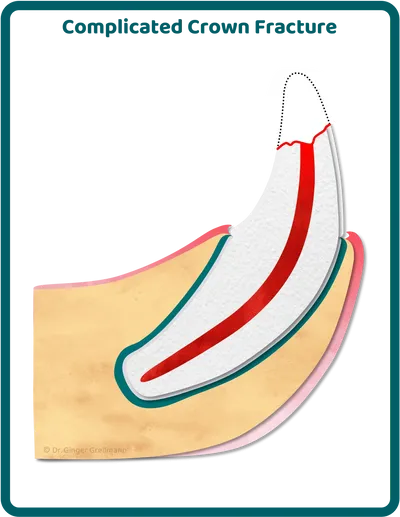
Complicated Crown Fractures:
Complicated crown fractures (CCF) involve both the enamel and dentin and result in visible pulp exposure. Pulp exposure can be painful when the tooth is still alive and continues to cause discomfort as it undergoes the process of dying. Although there may be a period when the tooth is not painful after it has died, the intrusion of oral bacteria into the pulp chamber can lead to deeper infection within the bone. Upon identification of this injury, treatment typically involves extraction or root canal therapy, with or without the addition of a prosthetic crown. This type of dental injury ranks among the most common traumatic dental injuries in cats and dogs.
Crown‐Root Fractures:
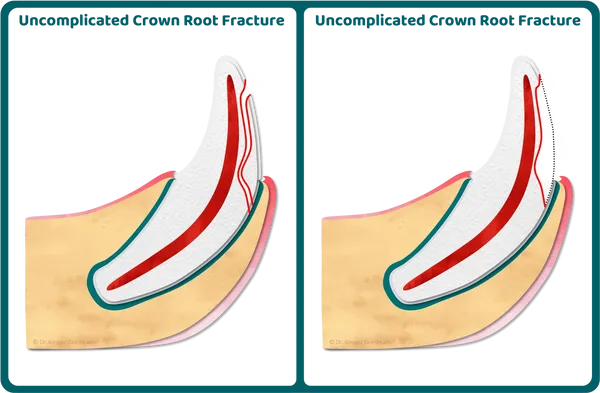
Crown-root fractures are a type of tooth fracture that involves both the crown (exterior of the tooth) and the root. The fragment may still be attached to the gingiva but mobile, or it may be entirely missing. When occurring on the maxillary (upper) 4th premolar tooth (carnassial tooth), this injury is often referred to as a "slab fracture." The fracture can be either uncomplicated (not involving the pulp tissue; i.e., uncomplicated crown-root fracture [UCRF]) or complicated (resulting in pulp exposure; i.e., complicated crown-root fracture [CCRF]). As with other types of tooth fractures, the choice of treatment will depend on the severity and location of the injury, but salvaging the tooth structure can be more challenging. This type of dental injury ranks as the 3rd most common traumatic dental injury in cats and dogs.


Root Fractures:
A root fracture occurs when the fracture is confined to the tooth root, involving cementum, dentin, and pulp of a tooth. In our pets, the frequency of this injury increases with age. Trauma to the tooth to the periodontal structures may be impaired in older patients due to changes in the periodontal ligament and alveolar bone. The treatment and prognosis are dependent on the location of the fracture within the tooth root. In some cases, these injuries may heal over time with proper care, while in others, the tooth may succumb to the injury, requiring extraction or advanced endodontic techniques for salvage.
Subluxation:
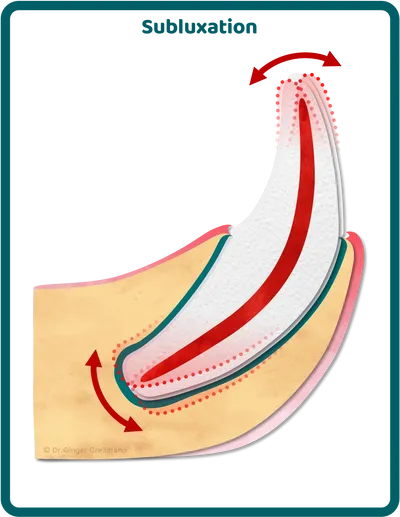
Subluxation injuries are likely underdiagnosed. Trauma to the tooth causing subluxation will manifest as increased, albeit often subtle, tooth mobility. Subluxated teeth typically heal within 7-10 days, and during this period, the pet should be fed soft food.
It is crucial to note that when a tooth undergoes a concussion (blunt force trauma), discoloration and tooth death may occur. It is essential to carefully observe any discoloration, no matter how slight, as it will influence the treatment recommendations.

Intrusive Dental Luxation:
An intrusive luxation occurs when the tooth is axially displaced into the alveolus. Visually, the tooth may appear shorter or even be missing. In the case of maxillary (upper) canine teeth, this injury can lead to the tooth being displaced into the nasal cavity.

Extrusive Dental Luxation:
An extrusive luxation occurs when the tooth is axially displaced out of the alveolus. In this injury, the periodontal ligament is either partially or entirely severed. An extruded tooth will exhibit an elongated appearance with some root exposure. This type of injury often leads to tooth death, and it may require root canal therapy if not extracted.

Lateral Dental Luxation:
A lateral luxation occurs when one cortex of the alveolus is fractured, and the tooth is displaced in any direction other than axially (e.g., intrusion or extrusion). Treatment for these teeth may involve dental splinting and root canal therapy.
Alveolar Fracture:
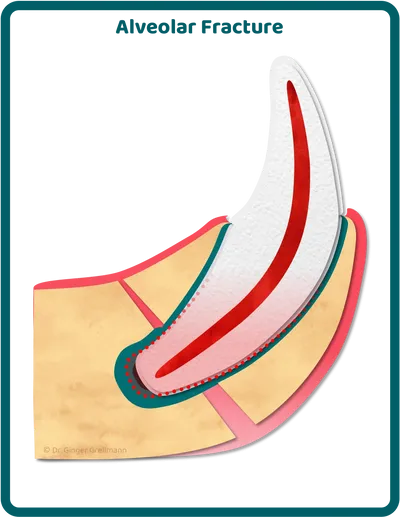
This term, primarily used in the context of traumatic dental injuries, is more commonly applied to humans than to cats or dogs. An alveolar fracture takes place when both cortices of the alveolar bone are broken, and the tooth can be luxated in any direction other than axially.
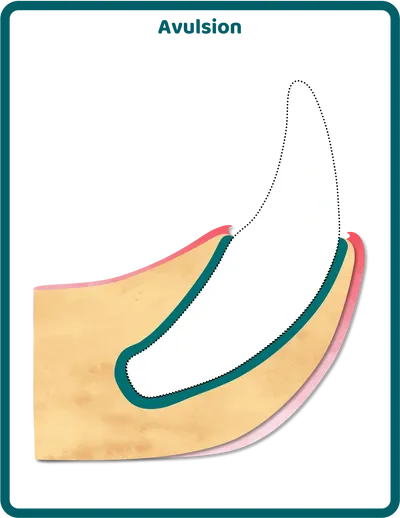
Avulsion (Ex‐Articulation):
An avulsion injury occurs when a tooth is completely displaced out of the alveolus, with the possibility of the tooth remaining attached to the gingiva. In this type of injury, the nerve, blood supply, and periodontal ligament are entirely severed. Dental healing is significantly influenced by the stage of tooth development, and mature adult teeth are more susceptible to experiencing tooth death.
In cases of avulsion, the critical first step is to replant the tooth as soon as possible, ideally within 5 minutes of the injury, and the tooth should be splinted. If immediate replantation is not feasible, the tooth should be stored in an appropriate medium, such as milk, saline, or saliva. Even with successful reimplantation, it's essential to recognize that root canal therapy will likely be necessary promptly to salvage the tooth; otherwise, the alternative may involve wound cleanup and considering it an extraction.