
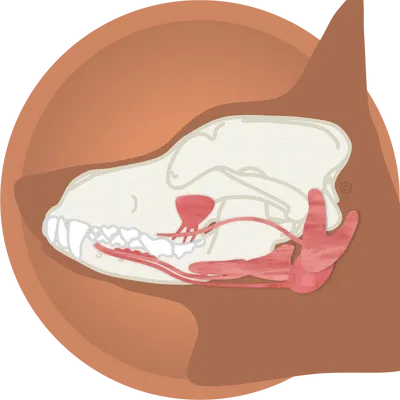
Salivary glands are specialized structures in the mouth and throat that produce saliva, a fluid essential for proper digestion and oral health. These glands secrete saliva into the oral cavity through ducts, helping to moisten food, initiate digestion, and maintain oral hygiene by washing away food particles and bacteria.
Salivary gland diseases are relatively rare occurrences in cats and dogs, with an overall incidence of only 0.3%. Sialadenitis, which involves inflammation of the salivary glands, is the most prevalent, representing 26% of the overall incidence rate of salivary diseases. Sialoceles, characterized by saliva accumulation in soft tissues, accounts for up to 9% of all salivary gland diseases. Sialoliths, are uncommon, with an incidence of 0.4%. Salivary gland neoplasia (tumors), are rare, occurring in approximately 0.17% of cases.
Congenital Salivary Gland Atresia
Congenital salivary gland atresia is a rare condition characterized by the blockage or absence of the orifice of a major salivary gland duct or part of the duct itself that is present at birth. This condition typically arises from genetic or developmental factors occurring during fetal development in the womb. There is no surgical treatment needed for this condition.
Congenitally Enlarged Parotid Ducts
Congenitally enlarged parotid ducts are a rare condition where the ducts responsible for draining saliva from the parotid glands are abnormally large from birth. Affected individuals may exhibit ptyalism, which is excessive drooling due to the enlarged ducts. The primary treatment option (if needed) is ligation of the salivary duct. This procedure involves surgically closing off the duct to prevent excessive saliva production and drooling.
Salivary Gland Neoplasia
Salivary gland neoplasia (cancer) is relatively uncommon, with an incidence of around 0.17%. It primarily affects older animals, with Siamese cats and Spaniels being more predisposed. The mandibular and parotid glands are the most commonly affected. Clinical signs may include dysphagia, exophthalmos, halitosis, and the presence of unilateral (one-sided), nonpainful, firm swelling in the upper neck, base of the ear, and upper muzzle or maxilla region.
Diagnosis and staging can involve fine needle aspirate with cytology (FNAC), thoracic radiographs, and advanced imaging (e.g., ultrasound, CT, and/or MRI) to assess the extent of the disease. Treatment aims at surgical removal of the diseased tissue (when appropriate), with postoperative therapy (e.g., chemotherapy and/or radiation therapy) sometimes recommended based on the biopsy results. Sentinel lymph node extirpation can be performed during primary tumor excision. The prognosis varies and is not correlated with histologic grade, but rather, it is associated with the stage of the disease.
Sialadenitis (Non-Infectious Sialadenitis; Necrotizing Sialometaplasia)
Sialadenitis is a condition characterized by inflammation of the salivary glands. It accounts for approximately 26% of salivary diseases. Potential causes include immune-mediated diseases, infections, injuries, and ischemic salivary gland disease. In some cases, there may be a possible link to hyperstimulation of the vagus nerve.
Clinical signs can be similar to those of sialadenosis and may include exophthalmos, hypersalivation, gland inflammation, and enlargement, pain on opening the mouth or palpating the glands, sialocele formation, vomiting, and, occasionally, epileptic activity. Diagnosis often requires fine needle aspirate with cytology (FNAC) and/or biopsy to differentiate this from other conditions.
Surgical removal of affected salivary glands and medical management with steroids and antibiotics may not consistently resolve clinical signs. Treatment should address any underlying esophageal disease and may involve a trial of Phenobarbital, which has shown some positive responses, suggesting a potential link to limbic epilepsy.
Phenobarbital may be prescribed. This medication may improve clinical signs, particularly if limbic epilepsy is suspected, but recurrence after discontinuation is possible, lifelong therapy may be necessary.
Need-To-Knows About Phenobarbital:
- Phenobarbital has a narrow safe therapeutic range for this medication. After every dosage change, a 2-week post-dosage-change recheck of phenobarbital blood level should be performed. Additionally, this medication needs to have a recheck examination and phenobarbital blood level (the goal is 15-45 µg/mL listed, with 15-35 µg/mL being preferred) every 6-12 months.
- Antiepileptic drugs (AED) have side effects and it is important to monitor the effects of the AED medications.
- Potential side effects include increased thirst, increased urination, & increased hunger.
- Nutritional management is important with the use of Phenobarbital because it can make your pet hungrier, resulting in weight gain and obesity; we may recommend weight management or weight loss. Additionally, dogs may develop fasting hyperlipidemia on AED medications, which should be managed using a low-fat diet.
- Phenobarbital is a controlled drug; therefore, it is important to carefully store these medications and keep them out of reach of children and people with a substance abuse history.
- Never abruptly stop an AED medication because there is a risk of the pet developing refractory seizures.
Sialadenosis
Sialadenosis is a condition characterized by the enlargement of the salivary glands, typically without inflammation or the presence of tumors. It often affects the mandibular salivary glands and may occasionally be associated with esophageal abnormalities. The exact cause of sialadenosis is unknown but may involve peripheral autonomic dysfunction or a form of limbic epilepsy. (Peripheral autonomic dysfunction refers to a disruption in the functioning of the autonomic nervous system outside of the brain and spinal cord, controlling involuntary bodily functions such as heart rate, digestion, and perspiration.) In some cases, sialadenosis may resemble Sjogren's syndrome in humans, with reported cases in cats showing lymphocytic-mediated destruction of exocrine glands. (Sjogren's syndrome is an autoimmune disorder characterized by dryness of the eyes and mouth due to inflammation and dysfunction of the glands that produce tears and saliva. Additionally, it can affect other organs, leading to symptoms such as joint pain, fatigue, and dry skin.)
Affected pets may exhibit symptoms such as dysphagia, gulping, lip smacking, hypersalivation (ptyalism), retching, and weight loss. Enlarged glands are usually non-painful. Diagnosis is often made through the exclusion of other conditions. Biopsy of the glands typically shows minimal to no changes in the affected glands.
Treatment options are limited, with glucocorticoids, antibiotics, and surgical gland removal proving ineffective.
Phenobarbital may be prescribed. This medication may improve clinical signs, particularly if limbic epilepsy is suspected, but recurrence after discontinuation is possible, lifelong therapy may be necessary.
Need-To-Knows About Phenobarbital:
- Phenobarbital has a narrow safe therapeutic range for this medication. After every dosage change, a 2-week post-dosage-change recheck of phenobarbital blood level should be performed. Additionally, this medication needs to have a recheck examination and phenobarbital blood level (the goal is 15-45 µg/mL listed, with 15-35 µg/mL being preferred) every 6-12 months.
- Antiepileptic drugs (AED) have side effects and it is important to monitor the effects of the AED medications.
- Potential side effects include increased thirst, increased urination, & increased hunger.
- Nutritional management is important with the use of Phenobarbital because it can make your pet hungrier, resulting in weight gain and obesity; we may recommend weight management or weight loss. Additionally, dogs may develop fasting hyperlipidemia on AED medications, which should be managed using a low-fat diet.
- Phenobarbital is a controlled drug; therefore, it is important to carefully store these medications and keep them out of reach of children and people with a substance abuse history.
- Never abruptly stop an AED medication because there is a risk of the pet developing refractory seizures.
Sialocele (Salivary Mucoceles)
Sialocele, also known as salivary mucoceles, is a condition characterized by the accumulation of saliva in the soft tissue surrounding the salivary glands. While not true cysts, these collections of saliva can occur in any gland and are typically associated with various causes including foreign bodies, infections, trauma, and neoplasia. Sialoceles account for less than 9% of all salivary gland diseases. They manifest as saliva-filled cavities within the subcutaneous tissue, lacking a fluid-producing cellular lining. These cavities are lined by inflammatory connective tissue and can originate from any salivary gland. Certain breeds, such as Australian Silky Terriers, Dachshunds, German Shepherds Dogs (GSD), and Poodles, may be predisposed.
The clinical signs vary depending on the affected gland. The location of the sialocele often determines the presenting complaint, indicating the offending gland. Diagnostic tools include fine needle aspiration and cytology (FNAC), advanced imaging (e.g., ultrasound, CT, or MRI), and histopathology. Surgical removal of affected glands, known as sialadenectomy, is the most frequently recommended treatment. Duct ligation and conservative approaches are less common due to high rates of recurrence. Surgical complications may include seroma, infection, bleeding, and recurrence (uncommon). The prognosis is excellent when the affected salivary gland and duct are completely removed.
Sublingual Sialocele (Ranula):
- Sublingual sialocele, commonly known as ranula, is a condition characterized by the leakage of saliva from the rostral sublingual salivary glands or duct. This results in a fluid-filled swelling typically located under the tongue. Clinical signs of sublingual sialocele include a deviation of the tongue and difficulty with prehending, chewing, or swallowing food, known as dysphagia.
2 Primary Treatment Options:
- Marsupialization: Ranula can be drained and marsupialized into the oral cavity. This procedure aims to create a permanent communication between the ranula cavity and the oral cavity, allowing continuous drainage of saliva.
- Sialadenectomy: Complete removal of the mandibular and sublingual salivary glands is recommended. Incomplete removal of the sublingual salivary chain may lead to recurrence of the sialocele. If recurrence occurs, further surgical intervention or advanced imaging (e.g., CT or MRI) may be necessary to identify and remove the remaining glandular tissue.
Sialoliths (Sialolithiasis)
Sialoliths, or salivary stones, are small, hard calcified structures that form within the ducts of the salivary glands. These stones can obstruct the flow of saliva, leading to symptoms such as swelling, pain, and difficulty with salivary gland function. These are rare occurrences with an incidence of approximately 0.4%. Chronic inflammation and radiation therapy of the head and neck can predispose individuals to sialolithiasis. Diagnosis is typically made through palpation, radiographs, or CT scans, with CT providing more specific information about the stone's location and size.
Parotid sialoliths are the most common and typically present as swelling on the lateral aspect of the face. They may be painful and can intermittently regress and reoccur.
Treatment options include:
- Sialadenectomy: Surgical removal of the affected duct-gland complex, along with the sialolith, is an option, especially if the stone originates from the mandibular and sublingual salivary glands.
- Marsupialization: This procedure aims to create a permanent communication between the ranula cavity and the oral cavity, allowing continuous drainage of saliva. This procedure can be considered if duct dilatation is the primary clinical sign.
- Primary Repair: Various surgical techniques may be employed depending on the stone's location and size.